Parts I–IV stayed with languages and single machines: accepters, NFAs, transducers. Real software is rarely one machine. Two processes, one lock, a bounded queue—several control flows share resources. That is concurrency, and a single Moore diagram for “the whole system” gets painful fast.
Petri nets are a standard way to draw that sharing. They are not a Linz chapter. Useful references: Murata’s survey (Petri Nets: Properties, Analysis and Applications, Proc. IEEE, 1989) and Reisig, Understanding Petri Nets.
Content:
- A real problem: two teammates, one staging server
- Why one finite automaton is awkward here
- Petri net vocabulary (as we need it)
- Model the staging protocol
- Enabling, firing, and a short scenario
- Reachability graph = DFA
- What the DFA answers: exclusion, B-safe, deadlock
- Design checklist
- Cheat sheet and self-check
The problem
Alice and Bob ship features to the same staging server.
Rules the team agrees on:
- Only one deploy may run at a time (staging is a mutex).
- Each person is either working locally or deploying.
- Starting a deploy takes the server; finishing a deploy frees it.
- Nobody may start a deploy while the other already holds staging.
Questions we actually care about:
- Can both be deploying at once under this protocol?
- Can the system get stuck with nobody able to move?
- Is there a bound on how “crowded” any local condition can get?
We will model this protocol as a Petri net, step through events by hand, then build a small DFA whose states are the global configurations.
Why not just draw one big DFA first?
Alice alone is a tiny two-state machine: Local ⇄ Deploying.
Bob is the same.
The server is another two-state machine: Free ⇄ Busy.
The real system is their product under a coupling: Alice may enter Deploying only when the server is Free, and that move makes the server Busy. Drawing the full product by enumerating triples (Alice, Bob, Server) works for three bits—and that is exactly what we will recover below—but the Petri-net drawing stays local. Each resource and each person is a place or two; the coupling is a shared arc pattern. When you add a third teammate or a second lock, you extend the net instead of redrawing an exponential state box from scratch.
So: problem first → net that mirrors the protocol → reachability DFA for the hard questions.
Vocabulary
| Term | Meaning | Example |
|---|---|---|
| Place (circle) | a local condition, state, or resource bucket that holds tokens | serverFree, aliceLocal |
| Transition (bar/box) | an event or action that can fire | aEnter (Alice starts a deploy) |
| Token (dot/count) | sits in a place; the condition holds, or one resource unit is available | a token in serverFree means staging is free |
| Arc | directed arrow: place → transition (input) or transition → place (output) | aliceLocal and serverFree into aEnter; aliceDeploy out |
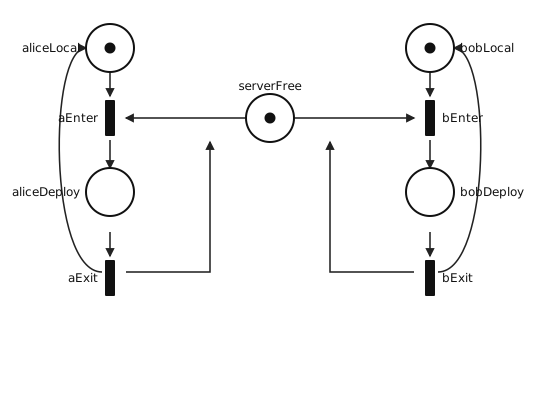
| Marking | token count across every place at once = one global configuration (often a digit string) | 10101 = both local, server free |
Initial marking $M_0$: how many tokens sit where at start.
Think of a token as “this condition holds” or “this resource unit is available.” In our story:
- a token in
aliceLocalmeans Alice is working locally; - a token in
serverFreemeans staging is free.
Model the staging protocol
Places
| Place | Meaning when it holds a token |
|---|---|
aliceLocal |
Alice is local |
aliceDeploy |
Alice is deploying |
bobLocal |
Bob is local |
bobDeploy |
Bob is deploying |
serverFree |
staging is free |
Alice is always in exactly one of her two places; same for Bob. The server lock is a single token that moves into a deploy place indirectly: taking it removes serverFree.
Transitions
| Transition | Consumes (inputs) | Produces (outputs) | English |
|---|---|---|---|
aEnter |
aliceLocal, serverFree |
aliceDeploy |
Alice starts deploy |
aExit |
aliceDeploy |
aliceLocal, serverFree |
Alice finishes |
bEnter |
bobLocal, serverFree |
bobDeploy |
Bob starts deploy |
bExit |
bobDeploy |
bobLocal, serverFree |
Bob finishes |
All arc weights are $1$ (one token in, one token out per arc).
Initial marking
Alice local, Bob local, server free:
\[M_0:\quad \texttt{aliceLocal}{=}1,\ \texttt{aliceDeploy}{=}0,\ \texttt{bobLocal}{=}1,\ \texttt{bobDeploy}{=}0,\ \texttt{serverFree}{=}1\]Digit string, places in that order: 10101.
Initial net ($M_0$). Circles are places, thin bars are transitions, black dots are tokens, arrows are arcs. Alice’s cycle on the left, Bob’s on the right, serverFree in the center:
Enabling and firing
Enabled. Transition $t$ is enabled at marking $M$ iff every input place of $t$ has at least one token (for weight $1$).
Fire. Atomically:
- remove one token from each input place;
- add one token to each output place.
If several transitions are enabled, any one may fire; each choice yields one next marking.
Scenario: Alice deploys, then Bob
Start 10101. Enabled: aEnter, bEnter (both see a local token and serverFree). Not both at once in one firing—we fire one transition at a time.
Fire aEnter:
- consume
aliceLocal,serverFree - produce
aliceDeploy
New marking: 01100 (Alice deploying, Bob still local, server not free).
Now enabled: only aExit. Bob cannot enter—no serverFree. Mutual exclusion is visible on the dots.
Fire aExit → back to 10101.
A symmetric path: 10101 -bEnter→ 10010 -bExit→ 10101.
Reachability graph = DFA
| Finite automaton | Petri net |
|---|---|
| state | marking |
| start | initial marking $M_0$ |
| input letter | name of the transition that fires |
| edge $q \xrightarrow{a} q’$ | fire $t$ at $M$, get $M’$ |
Construction
- Table each transition’s inputs and outputs (done above).
- Start from $M_0$.
- BFS: for each reached marking, for each enabled $t$, fire and add an edge labelled $t$.
- Stop when no new markings appear.
Name markings with digit strings (one digit per place, fixed place order).
Full BFS for staging
| Marking | Meaning (nonzero) | Enabled | Successors |
|---|---|---|---|
10101 |
both local, server free | aEnter, bEnter |
01100, 10010 |
01100 |
Alice deploying | aExit |
10101 |
10010 |
Bob deploying | bExit |
10101 |
No other markings. In particular 01010 (both deploying) never appears.
#states
10101
01100
10010
#initial
10101
#alphabet
aEnter
aExit
bEnter
bExit
#transitions
10101:aEnter>01100
01100:aExit>10101
10101:bEnter>10010
10010:bExit>10101
On the alphabet of transition names this graph is a DFA: from a marking, each enabled transition has exactly one successor marking. Nondeterminism of the net is only “which enabled transition do we pick?”—each pick is still a deterministic edge.
What the DFA answers
Mutual exclusion (the original worry)
Every reachable marking has at most one of aliceDeploy, bobDeploy set. Equivalent check: scan digit strings—positions for those places are never both 1. So under this protocol, Alice and Bob cannot overlap on staging.
B-safe and 1-safe
B-safe: in every reachable marking, no single place holds more than $B$ tokens.
- 1-safe (often just “safe”): at most one token per place everywhere.
- 2-safe: at most two per place, and so on.
$B$ is not the total number of tokens in the net. Here the net always has three tokens in total, but each place’s count is $0$ or $1$. Max digit in the DFA is 1 → 1-safe (hence also 2-safe, …). Course “largest $B$” questions usually want that tight max digit.
Deadlock-free
Deadlock-free iff every reachable marking enables at least one transition. Equivalently: the reachability graph has no sink.
Here each of 10101, 01100, 10010 has an outgoing edge → deadlock-free. Someone can always move: either take the free server or finish the active deploy.
Reachability of a concrete marking
Is {aliceLocal→0, aliceDeploy→1, bobLocal→1, bobDeploy→0, serverFree→0} reachable?
Digit string 01100—yes, via aEnter.
Enabled there: {aExit} only.
Side note: when safeness breaks
If a buggy transition produced an extra serverFree without consuming a deploy, you could stack lock tokens and the digit for serverFree would climb. The reachability graph would show digits 2, 3, … and the net would fail 1-safe (and maybe every finite $B$ if unbounded). The DFA is how you notice—not by re-reading the English rules.
A different failure mode: a deploy exit that forgets to return serverFree. Then 01100 has no enabled transition → a sink → deadlock. Again the graph makes it obvious.
Design checklist (concurrency → Petri net)
- Name the shared resources and the participants.
- One place per condition you care about (idle / busy / free slot / …).
- One transition per event; list consume / produce.
- Fix $M_0$ (who starts where, how many resource tokens).
- Build the reachability DFA with digit strings.
- Read off: forbidden markings absent? max digit ($B$)? sinks (deadlock)?
Same habit as Part IV’s controller brief: write assumptions, then check behaviours against paths—here the paths are firing sequences.
Cheat sheet
problem first     shared resource + several actors
place/token       local condition or resource unit
marking           whole assignment = one DFA state
enabled           every input place has enough tokens
fire              consume inputs, produce outputs
reachability DFA  markings as states, transition names as letters
digit string      one digit per place = token count
1-safe / B-safe   never more than 1 / B tokens on any one place
deadlock-free     every reachable marking enables ≥ 1 transition
mutex pattern     take lock token to enter; return it on exit
Self-check
- Marking
{aliceLocal→1, aliceDeploy→0, bobLocal→0, bobDeploy→1, serverFree→0}as a digit string (same place order as above)? - From
10101, can you fireaEnterthenbEnterwithout an exit in between? - If a reachable marking shows digit
2onserverFree, can the net be 1-safe? - Why is “$B$ = total tokens in the net” wrong for this example?
- Edit
aExitso it only restoresaliceLocal(forgetsserverFree). What goes wrong, and which marking is the sink?
Answers
1. 10010.
2. No. After aEnter the marking is 01100 and bEnter is not enabled.
3. No.
4. Safeness bounds each place. This net has three tokens in total but is still 1-safe.
5. After aEnter you reach 01100 with nothing enabled → deadlock; staging is lost forever.
References
- Murata, T. Petri Nets: Properties, Analysis and Applications. Proc. IEEE, 1989.
Read in BetterReads - Reisig, W. Understanding Petri Nets.
Read in BetterReads - Part II (finite automata background for the reachability DFA).
- Part IV (Moore/Mealy controllers—one machine; this part is several machines plus resources).